
Norbert's Gambit: the Canadian currency hack


Part 5 of 9
This article is part of our Going deeper series.
Short answer: Norbert’s Gambit is a way to convert CAD to USD at near-mid-market rates instead of paying your brokerage’s 1.5% to 2.5% conversion markup. You buy a dual-listed ETF like DLR in CAD, journal it to the USD side as DLR.U, and sell. Questrade, Interactive Brokers, and the big banks support it. As of 2026, Wealthsimple does too: its Norbert’s Gambit on Wealthsimple feature (in beta, web only) journals DLR for a flat $9.95 plus tax, which beats its 1.5% Core FX fee once you’re converting roughly $800 or more.
I remember when the Canadian dollar was at parity with the US dollar. Buying US stocks felt almost free. Then the loonie weakened, and suddenly every purchase on a US exchange came with a built-in currency penalty. People around me kept saying the dollar would never recover. It did, partially, then slid again. The exchange rate became this thing I couldn’t ignore.
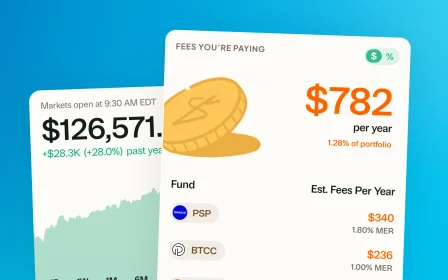
But the exchange rate itself wasn’t the real problem. The real problem was what my brokerage charged me to convert currency. The fee doesn’t show up as a line item. It’s baked into the exchange rate they give you, which is 1.5% to 2.5% worse than the real mid-market rate. On a $10,000 conversion, that’s $150 to $250 gone. Do it a few times a year and the cost adds up fast.
Norbert’s Gambit is a workaround that Canadian investors have been using for years to convert currency at a fraction of the cost. It’s not complicated, but it does require a few steps. This isn’t financial advice, and you should verify the specifics with your brokerage before trying it.
How it works
The idea is simple. Instead of asking your brokerage to convert your currency (and paying their markup), you use an interlisted security, something that trades on both the Toronto Stock Exchange in Canadian dollars and a U.S. exchange in U.S. dollars, to effectively convert the currency yourself.
The most commonly used security for this is DLR (Global X U.S. Dollar Currency ETF), which trades as DLR on the TSX in Canadian dollars and DLR.U on the TSX in U.S. dollars. It’s the same fund, just priced in two currencies.
The steps:
| Step | What you do |
|---|---|
| 1 | Buy DLR with your Canadian dollars (on the TSX) |
| 2 | Wait for the trade to settle (typically 1 business day for ETFs) |
| 3 | Call your brokerage (or use their online journal feature) to journal the shares from DLR to DLR.U |
| 4 | Sell DLR.U, and the proceeds land in your account in U.S. dollars |
You’ve now converted CAD to USD. The only costs are the trading commissions (if any) and the tiny bid-ask spread on DLR, which together usually come to well under 0.20%. Compare that to 1.5-2.5% through the brokerage’s automatic conversion.
The math on a real conversion
Say you want to convert $20,000 CAD to USD.
| Method | Approximate cost |
|---|---|
| Brokerage auto-conversion (1.5-2.5%) | $300 to $500 |
| Norbert’s Gambit | $5 to $30 |
On a single conversion, you could save $300 or more. If you’re converting currency multiple times a year, or converting larger amounts, the annual savings can be significant. Over a career of investing, we’re talking thousands of dollars that stay in your portfolio instead of going to your brokerage.
Does Wealthsimple support Norbert’s Gambit?
Yes, now. For years the answer was no, and a lot of older guides (and earlier versions of this one) still say so. That changed in 2026: Wealthsimple rolled out a built-in Norbert’s Gambit feature, currently in beta and web only, that does the DLR-to-DLR.U journal for you for a flat $9.95 plus tax. It beats Wealthsimple’s 1.5% Core FX fee once you’re converting roughly $800 or more, so the old workaround of opening a second brokerage just to convert currency is no longer the only option for Wealthsimple customers.
The full walkthrough, the journaling fee, the app-versus-web limits, and the break-even math live in the dedicated guide: Norbert’s Gambit on Wealthsimple, step by step.
Which other Canadian brokerages support Norbert’s Gambit?
Not all brokerages handle this the same way. Here’s how the rest of the field compares.
Can you use Norbert’s Gambit on Questrade?
Yes. Questrade makes it relatively straightforward. You can buy DLR, then contact them to journal the shares to DLR.U (some people report success doing this online, others need to call). The process usually takes 1 to 2 business days. Questrade has long been one of the most popular brokerages for this technique.
Norbert’s Gambit at the big banks (TD, RBC, BMO, CIBC)
Big bank brokerages (TD Direct Investing, RBC Direct Investing, BMO InvestorLine, CIBC Investor’s Edge) generally support Norbert’s Gambit, though the process varies. Some require a phone call to journal shares. Some make you wait for full settlement. It works, but it can feel clunky compared to Questrade.
Can you do Norbert’s Gambit at Scotia iTrade?
Yes. Scotia iTrade supports Norbert’s Gambit with DLR and DLR.U. The pattern is the same as the other bank brokerages: buy DLR, wait for it to settle, then journal the shares to the U.S. side (usually by phone or secure message) before selling DLR.U for U.S. dollars. It’s a few more steps than Questrade, but on a larger conversion it still saves you the 1.5 to 2 percent FX markup.
Can you do Norbert’s Gambit at National Bank Direct Brokerage?
Yes. National Bank Direct Brokerage (NBDB) supports Norbert’s Gambit using DLR and DLR.U. The journal step is manual and usually means phoning in rather than a one-click flow, which is normal across the bank brokerages. Because NBDB charges $0 commission on stock and ETF trades, the only real cost of the gambit there is the small bid-ask spread on DLR. The NBDB review covers the platform in more depth.
Norbert’s Gambit on Interactive Brokers
Interactive Brokers Canada supports Norbert’s Gambit and is popular with higher-volume DIY investors. The journal process is well-documented and the underlying FX rates are already close to mid-market, which makes the gambit less essential there but still useful when you want zero spread.
Going the other way
Norbert’s Gambit works in reverse too. If you have U.S. dollars and want to convert to Canadian, you buy DLR.U, journal to DLR, and sell for Canadian dollars. Same process, opposite direction.
This comes up when you receive U.S. dollar dividends and want to consolidate into Canadian, or when you’re selling U.S. positions and bringing the money home.
The catches
It’s not entirely frictionless. A few things to be aware of:
Settlement time. After you buy DLR, you typically need to wait for the trade to settle before you can journal the shares. This means you’re exposed to small fluctuations in the exchange rate during that window. On large amounts, the exposure is minimal relative to the savings, but it’s not zero.
The journaling step. Some brokerages make this easy, some make it annoying. You might need to call during business hours. Some charge a small fee for the journal. Check your brokerage’s process before you start.
Registered vs. non-registered accounts. Norbert’s Gambit works in TFSAs, RRSPs, and non-registered accounts. In a non-registered account, the buy-sell of DLR could technically trigger a small capital gain or loss, though it’s usually negligible since you’re holding for such a short time.
It’s a bit of effort. If you’re converting $500, the savings might not be worth the hassle. But once you’re converting $5,000 or more, the math becomes pretty clear.
Why it matters
Currency conversion is one of those fees that erode returns because they’re invisible. It doesn’t show up on a statement as “currency conversion fee: $350.” It just shows up as a slightly worse exchange rate that you’d never notice unless you compared it to the actual rate that day.
If you’re investing in U.S. markets, and a lot of Canadian investors do (whether through U.S.-listed ETFs or individual U.S. stocks), understanding this one technique can save you more money over your investing life than almost any other optimization. It’s not glamorous. It takes 20 minutes the first time and 5 minutes every time after. But the savings are real.
If you’d rather avoid the whole thing, Canadian-listed all-in-one ETFs like XEQT and VEQT hold U.S. and international stocks without requiring you to convert currency at all. The fund handles it internally. For a lot of people, that simplicity is worth more than the marginal savings of buying U.S.-listed equivalents directly.
The fees, the returns, the details buried in your statements add up, once you can actually see them in one place. If you ever want everything you own in one view, that's what Greenline is for.
More in The Fine Print
Norbert's Gambit on Wealthsimple: the step-by-step

Currency-hedged ETFs: do you actually need them?

Brokerage comparison: what to look for in Canada

What you're actually paying in investment fees
Norbert's Gambit on Wealthsimple: the step-by-step
Wealthsimple now does Norbert's Gambit in beta: a flat $9.95 DLR journal, web only. Step-by-step, the journaling fee, and when it beats the 1.5% FX fee.
Currency-hedged ETFs: do you actually need them?
Brokerage comparison: what to look for in Canada
Big-bank brokerages vs independents like Wealthsimple and Questrade, compared on what actually costs you: trading fees, FX markups, and inactivity charges.