Individual stocks vs ETFs: how to think about both


Part 2 of 9
This article is part of our Going deeper series.
Short answer: ETFs give you instant diversification across hundreds or thousands of companies for a low fee and zero research time. Individual stocks let you concentrate on companies you understand but require ongoing monitoring. A core-and-satellite mix (mostly ETFs, a few individual names) is a common compromise.
This isn’t a debate with a winner. I hold both individual stocks and ETFs. I’ve made great returns picking stocks and I’ve also watched positions go nowhere for years while the index quietly climbed. Both approaches are real parts of my portfolio, and they serve different purposes.
None of this is financial advice. Your situation, risk tolerance, and time horizon are yours. I’m sharing how I think about this, not telling you what to buy.
| Dimension | Individual stocks | ETFs |
|---|---|---|
| Diversification | 5–10 names, concentrated | Hundreds to thousands of companies |
| Ongoing cost | None after purchase | 0.05% – 0.25% MER (broad index) |
| Time and research | Ongoing — earnings, news, monitoring | Almost none — buy and hold |
| Tax efficiency | You control timing of gains/losses | Distributions can trigger tax in non-registered accounts |
| Best for | Engaged investors, conviction picks, sector tilts | Default core, hands-off compounding, long-term wealth building |
What each approach actually looks like
Buying an ETF like XEQT means you own a slice of thousands of companies across the world. You buy one thing, contribute regularly, and that’s it. No research, no monitoring, no decisions about when to sell. It’s the investing equivalent of a slow cooker: set it up, walk away, come back later to something good.
Buying individual stocks means you’re choosing specific companies. You’re reading earnings reports, following industry news, forming opinions about management teams and competitive advantages. When a stock drops 15% on a bad quarter, you need to decide: is this a buying opportunity or a warning sign? Nobody makes that call for you.
Both are valid. But they require very different amounts of your time and attention.
Diversification: the numbers are stark
One share of XEQT holds pieces of roughly 9,000 companies across dozens of countries. If any single company in there goes bankrupt, you barely notice. The fund rebalances, replaces it, and moves on.
A portfolio of 5 to 10 individual stocks is a fundamentally different thing. Each position represents 10% to 20% of your money. If one of those companies has a bad year, or a bad scandal, or a bad product launch, you feel it. And if two of them struggle at the same time, your portfolio can lag the broader market by a wide margin.
This isn’t hypothetical. Plenty of Canadian investors held heavy positions in companies like Nortel, BlackBerry, or Bombardier at various points, all companies that looked like safe bets at the time. Concentration works both ways. It amplifies gains, but it also amplifies losses.
What it costs
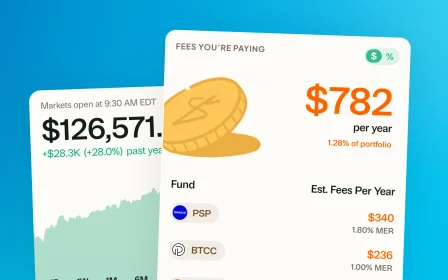
ETFs charge a Management Expense Ratio (MER) that gets deducted automatically from the fund’s value. For broad index ETFs, this ranges from about 0.05% to 0.25% per year. On a $50,000 portfolio, that’s $25 to $125 annually. You never see a bill. It just slightly reduces your returns.
Individual stocks have no ongoing management fee. Once you own shares of Royal Bank or Shopify, there’s no annual cost to hold them. At most brokerages in Canada, buying and selling is commission-free now, so the trading costs have mostly disappeared too.
On pure cost, individual stocks win. But cost is only one factor, and saving 0.20% per year doesn’t help if your stock picks underperform the index by 3%.
Time and research
This is where the gap gets real.
An all-in-one ETF requires almost nothing from you. Buy it. Set up automatic contributions if your brokerage supports it. Check on it once or twice a year if you want. That’s it. The fund handles rebalancing, reinvesting, and adjusting holdings as companies enter and leave the index.
Individual stocks require ongoing attention. Quarterly earnings come out and you need to at least skim them. Management changes, competitive threats, regulatory shifts, all of it matters when you own a single company. You don’t need to be glued to your screen, but you do need to stay informed. If you stop paying attention to a stock you own, you’re not investing anymore. You’re just hoping.
The point isn’t to find the perfect investing approach. It’s to find one you’ll actually stick with for decades.
Some people genuinely enjoy this research. I do, for a handful of positions. But I also know that if I had to do this level of diligence for my entire portfolio, I’d burn out or start cutting corners. Having ETFs as the core means the research I do on individual stocks is a choice, not a burden.
Tax implications
This one matters more than you might expect, especially in a non-registered account.
When you own individual stocks, you control the timing of your gains and losses. If one position is down and you want to offset gains elsewhere, you can sell it, realize the capital loss, and use that loss to reduce your tax bill. This is called tax-loss harvesting, and it’s one of the genuine advantages of holding individual positions.
With an ETF, the fund manager handles all the buying and selling internally. You don’t choose when gains or losses get realized. The ETF might distribute capital gains to you at year-end even if you haven’t sold a single share. In a TFSA or RRSP this doesn’t matter because the account shelters you from tax. But in a non-registered account, it’s worth knowing that you’re giving up some control.
That said, ETFs (especially index ETFs) tend to be quite tax-efficient because of how they’re structured. The capital gains distributions are usually small. And for most people, the simplicity of the ETF outweighs the tax flexibility of individual stocks.
The emotional side (this matters more than people admit)
There’s a feeling you get when you own shares of a company you interact with in real life. Walking past a Dollarama and thinking, “I’m a shareholder of that.” Paying for lunch at a restaurant chain you own stock in and noticing whether it’s busy. Downloading an app update from a tech company in your portfolio and having an opinion about whether it’s any good.
That engagement is real, and I think it’s underrated. For some people, owning individual companies is what keeps them interested in investing at all. It turns your portfolio from an abstract number into something connected to the world you walk through every day.
I bought Shopify early because I was working in e-commerce at the time and I could see what they were building. I bought Chipotle during the E. coli crisis because I believed the brand would recover. I bought Air Canada during the March 2020 crash because I thought travel would come back. Those weren’t just financial decisions. They were opinions about the world I was watching closely.
Not all of those opinions were right. But the process of forming them, of paying attention, of having a reason to care about business news, that process made me a better investor overall. It kept me engaged through periods when a set-and-forget ETF strategy might have felt too passive to hold my interest.
The honest risk: most stock pickers underperform
Here’s the part that’s uncomfortable to say out loud, especially after sharing my own stock-picking stories.
The data is clear: the majority of individual stock pickers underperform the index over long periods. Study after study shows this, and it’s not just amateurs. Most professional fund managers, people who do this full-time with teams of analysts, fail to beat a simple index fund over 10 or 20 years.
There’s also survivorship bias at play. The stories you hear are mostly from people whose picks worked out. Nobody writes a blog post about the stock they held for three years that went sideways while the index returned 40%. But that’s the more common outcome. For every person who bought Shopify at $20, there’s someone who bought Nortel at $100 or BlackBerry at $140 and held on too long.
My own track record is mixed. The winners I mentioned are real, but I’ve also held positions that did nothing while the broad market climbed. When I honestly compare my individual stock returns to what I would have earned in a simple index fund, the index would have been close, and with far less effort and stress.
The practical answer for most people
If you’re looking for the approach that’s most likely to work over the long run with the least effort, it’s ETFs. A single all-in-one fund like XEQT or VEQT gives you global diversification, automatic rebalancing, rock-bottom fees, and zero maintenance. For most Canadian investors, this is the core that should be doing the heavy lifting.
But if you enjoy following companies, if you find the research genuinely interesting, if owning individual stocks keeps you engaged with your finances in a way that a single ETF wouldn’t, then there’s room for both. A common approach is to keep 80% to 90% of your portfolio in broad index ETFs and allocate 10% to 20% to individual stocks you believe in.
That smaller allocation lets you scratch the stock-picking itch without putting your financial future at risk if your picks don’t work out. If your individual stocks outperform, great. You’ve added a bit of extra return. If they underperform, the damage is contained because the core of your portfolio is doing its job.
The one thing I’d avoid is going all-in on individual stocks without a very clear reason. Unless you have deep expertise in a specific industry and the time to stay on top of your positions, concentrated portfolios introduce risk that most people don’t need to take.
What I actually do
My portfolio is mostly broad index ETFs. That’s the foundation. On top of that, I hold a handful of individual Canadian and U.S. stocks in companies I know well and follow closely. The ETFs give me peace of mind. The individual stocks give me something to think about.
I don’t think either approach is wrong. I think the wrong move is picking one because the internet told you to and never questioning whether it fits how you actually invest. Some people thrive with the simplicity of a single ETF. Some people need the engagement of owning companies to stay interested. Most people, if they’re honest, probably benefit from some combination of both.
The point isn’t to find the perfect approach. It’s to find one you’ll actually stick with for decades.
Greenline shows you everything in one view, whether you hold a single ETF or a mix of index funds and individual stocks across multiple accounts. Whatever your approach, seeing the full picture helps you understand what role each position plays.
The big picture only comes together when every account you have sits in a single view. Seeing it all in one place is what we built Greenline to do, if you ever want a hand.
More in The Big Picture

How to pick ETFs in Canada

Just buy XEQT? The one-ETF strategy explained
Active vs passive investing: what the data says and what it misses

PLTU, RBNU, METU: how 2X single-stock ETFs actually work

The trades that got you here
How to pick ETFs in Canada
Everyone has a list of 'best ETFs.' Nobody teaches you how to evaluate them yourself. Here's what to actually look at before you buy.
Just buy XEQT? The one-ETF strategy explained
Active vs passive investing: what the data says and what it misses
PLTU, RBNU, METU: how 2X single-stock ETFs actually work